How Battery Backup Power Supports Vaccines for Children (VFC) Compliance
The Vaccines for Children (VFC) Program provides vaccines to eligible children younger than 19, including those who are Medicaid-eligible or enrolled, uninsured, underinsured and receiving care at a Federally Qualified Health Center or Rural Health Clinic, or American Indian/Alaska Native. In turn, participating providers are responsible for protecting this publicly funded vaccine supply, including maintaining appropriate storage temperatures and preparing for emergencies that could disrupt the cold chain.
A power outage can quickly place vaccine inventory at risk. Battery backup power, combined with temperature monitoring, alert systems, and written emergency procedures, can help VFC providers maintain required storage conditions and respond more effectively when utility power is interrupted.
Understanding VFC Storage and Handling Responsibilities
The CDC’s VFC Operations Guide is the primary source of guidance for participating providers. The CDC Vaccine Storage and Handling Toolkit provides additional information and best practices, while state and local immunization programs may establish further requirements.
According to CDC guidance, vaccine storage units must generally maintain the following temperature ranges:
- Refrigerators: 36°F to 46°F (2°C to 8°C)
- Freezers: -58°F to +5°F (-50°C to -15°C)
- Ultra-cold freezers: -130°F to -76°F (-90°C to -60°C)
Providers must also follow the manufacturer’s product-specific storage instructions. Exposure to temperatures outside the appropriate range may reduce vaccine potency. This loss may not be visible, and once potency is lost, it cannot be restored. Affected vaccines may need to be isolated, evaluated, and potentially discarded. Patients who receive compromised doses may also require revaccination.
Preparing for Power Outages
Vaccine refrigerators and freezers depend on a continuous supply of electricity. During an outage, internal temperatures can gradually move outside the acceptable range. How quickly this occurs depends on the storage unit, room temperature, amount of inventory, equipment condition, and whether the door remains closed.
VFC providers should maintain written standard operating procedures covering emergencies such as power outages, equipment failures, severe weather, and natural disasters. These procedures should explain how staff will monitor storage conditions, respond to alerts, access the facility after hours, and transport vaccines if necessary.
Without backup power, providers may need to relocate vaccines to an alternate storage facility. Emergency transportation introduces additional steps and risks, including locating appropriate containers, maintaining continuous temperature monitoring, coordinating after-hours access, and confirming that another facility has suitable storage capacity.
Where Battery Backup and Alert Systems Fit
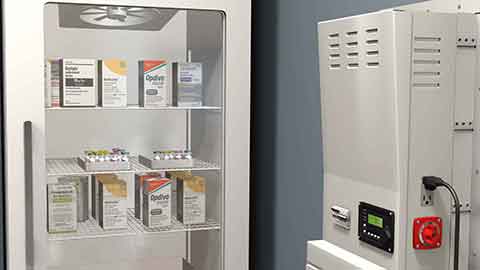
CDC guidance states that a backup battery power source can be used in lieu of an on-site generator for emergency vaccine storage. A properly designed system can begin supplying electricity when utility power is interrupted, allowing connected refrigerators, freezers, digital data loggers, and other essential equipment to remain operational.
For VFC providers, battery backup power can help maintain required vaccine storage temperatures, reduce the likelihood of a temperature excursion, and provide staff with more time to assess the outage. It may also reduce or, when sized adequately, eliminate the need to pack and transport vaccines during a short-term interruption.
Large clinics may use more extensive backup power systems along with security or alarm setups that notify appropriate personnel when an outage occurs. These alerts are particularly important when a facility is closed or unoccupied. Prompt notification allows designated staff to verify system status, monitor temperatures, and initiate the facility’s emergency procedures before storage conditions are compromised.
Battery backup does not replace digital data loggers, emergency procedures, staff training, or an alternate storage agreement. Instead, it provides another major layer of protection within the clinic’s broader cold-chain strategy.
Testing and Maintaining Backup Power
A backup system only provides meaningful protection if it is ready to operate when needed. If a provider location uses backup power, CDC requires the system to be tested quarterly and serviced annually. Testing procedures and maintenance schedules should follow the manufacturer’s specifications.
Facilities should document completed inspections, tests, maintenance, and service. Staff should also confirm that security systems, power outage alerts, and remote notifications reach the appropriate personnel. Changes in vaccine inventory, storage equipment, or electrical loads should trigger a review of whether the existing system still provides sufficient capacity and runtime.
Selecting the Right Battery Backup System
Backup power should be sized for the specific equipment it will support. Refrigerators and freezers can require more power when the compressor starts than during normal operation, so system selection should account for both continuous electrical demand and startup surge requirements.
The required runtime will depend on local outage history, facility accessibility, staff response time, inventory value, and the availability of alternate storage. Clinics should also consider whether temperature monitoring devices, communications equipment, alarm systems, and network hardware require continuous power during an outage.
Strengthening the VFC Emergency Plan
Battery backup power can help VFC providers protect vaccine inventory, maintain cold-chain continuity, and carry out emergency procedures more effectively. However, no commercial product is independently certified or endorsed by the CDC as “VFC-compliant.” Each provider remains responsible for following the VFC Operations Guide and any additional requirements established by its state or local immunization program.
Medi-Products works with healthcare facilities to evaluate vaccine storage equipment, electrical demand, required runtime, monitoring needs, and installation requirements. A properly sized, tested, and maintained battery backup system can strengthen a provider’s emergency plan and help protect vaccines intended for children who depend on the VFC Program.