The average American electricity customer loses power a little more than once a year and is without electricity for about 126 minutes annually, according to the U.S. Energy Information Administration. In most settings, that is an inconvenience. In a pharmacy or healthcare facility, it can be very, very expensive!
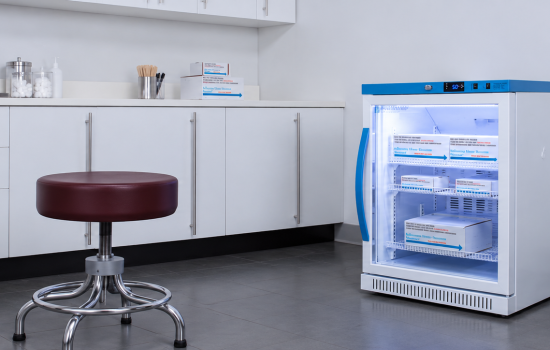
For operations that depend on refrigeration, a brief outage can put medications, vaccines, biologics, and other temperature-sensitive inventory at immediate risk. The financial exposure is not theoretical. It is built into the value sitting inside the refrigerator.
That is where the case for battery backup becomes unusually straightforward.
In many industries, return on investment can be hard to pin down. In pharmacy and healthcare refrigeration, the math is often clearer. When the cost of backup protection is weighed against the potential loss from a single outage, the system can justify itself faster than many decision-makers expect.
A Short Outage Can Create a Big Loss
The problem is not simply that outages happen. It is that when they happen, healthcare refrigeration has very little tolerance for disruption.
For facilities that depend on medical or pharmacy refrigeration, even a brief outage can create serious risk. A temperature excursion may compromise product integrity, trigger waste, create compliance concerns, and force staff into emergency response mode.
The cost is rarely limited to the product itself. An outage can also lead to:
- staff time spent managing the event
- replacement and resupply challenges
- documentation and compliance burdens
- disruption to patient care or daily operations
For a pharmacy, clinic, hospital department, or healthcare facility, the financial exposure from one event can easily outweigh the investment required to prevent it.
Why the ROI Tends to Be Strong
The national outage data matters because it shows that loss of power is not rare. It is a recurring condition of operating any facility connected to the grid.
That matters more in healthcare than in most industries because the value at risk is concentrated and time-sensitive. A facility may go months or years without a serious issue, but the underlying exposure remains. And when an outage does affect refrigeration, the cost of that one event can outweigh the investment required to prevent it.
This is what makes battery backup different from many other capital decisions. It is not a speculative efficiency upgrade or a loosely defined operational improvement. It is a direct form of risk reduction tied to a clearly identifiable asset: refrigerated inventory.
In that sense, the ROI is not abstract. It is often a comparison between the cost of protection and the cost of losing what is already on hand.
The Financial Logic Is Only Part of the Story
The operational argument is just as strong.
Battery backup reduces uncertainty during an outage. It gives staff time. It keeps critical refrigeration running. It lowers the likelihood of a temperature excursion and reduces the need for emergency response measures. In environments where continuity matters, that kind of stability has value beyond the balance sheet.
It also changes the posture of the organization. Instead of reacting to grid instability after the fact, facilities are prepared for it in advance.
That matters in healthcare, where the consequences of interruption are measured not just in dollars, but in workflow disruption, documentation burden, and risk to patient-facing operations.
A Practical Decision, Not Just a Technical One
Power reliability is often treated as a facilities issue. In reality, for pharmacies and healthcare providers, it is also an inventory protection issue, a compliance issue, and a financial issue.
As the value of refrigerated medications continues to rise, so does the cost of being unprotected. The rise in popularity of the new GLP-1 medications, which also require refrigeration, compounds the risk. That shifts the conversation. The question is no longer whether outages are possible. The data already answers that. The question is whether it makes financial sense to leave high-value inventory exposed to a predictable operational risk.
In most cases, it does not.
We Can Run the Numbers
Every facility is different. Inventory levels vary. Refrigeration loads vary. Runtime requirements vary.
That is why the most useful ROI discussion is a specific one.
At Medi-Products, we can run a simple ROI analysis based on your approximate inventory value and application. The goal is not to generalize. It is to show, in practical terms, what the exposure looks like and how it compares to the cost of protection.
For many facilities, the conclusion is the same.
It just makes sense.
Call us today at 1.800.765.3237 or fill out the form below to schedule a free, no-obligation ROI presentation with one of our emergency power experts.